May 27, 2026 | Tokyu Kabukicho Tower
- A Noh Spirit Meets the Neon Lights of Kabukicho
- Opening the Curtain Like Hosts
- The Stories Begin
- Dance That Stops People in Their Tracks
- First Steps on Stage
- Every Journey Begins with
- Takasago
- Dancing Together
- The Dance That Marks a Lifetime
- More Than Technique
- “Why Should Hosts Dance?”
- Looking Ahead
- Continue the Journey
- Meet the Members in Kabukicho
“Everyone looks like they’re truly enjoying themselves.”
Watching the stage with a gentle smile, Yamamura Wakashizuki, master of the Yamamura School of Kamigata-mai, quietly shared this observation.
It was a simple remark, yet it perfectly captured the atmosphere of the evening.
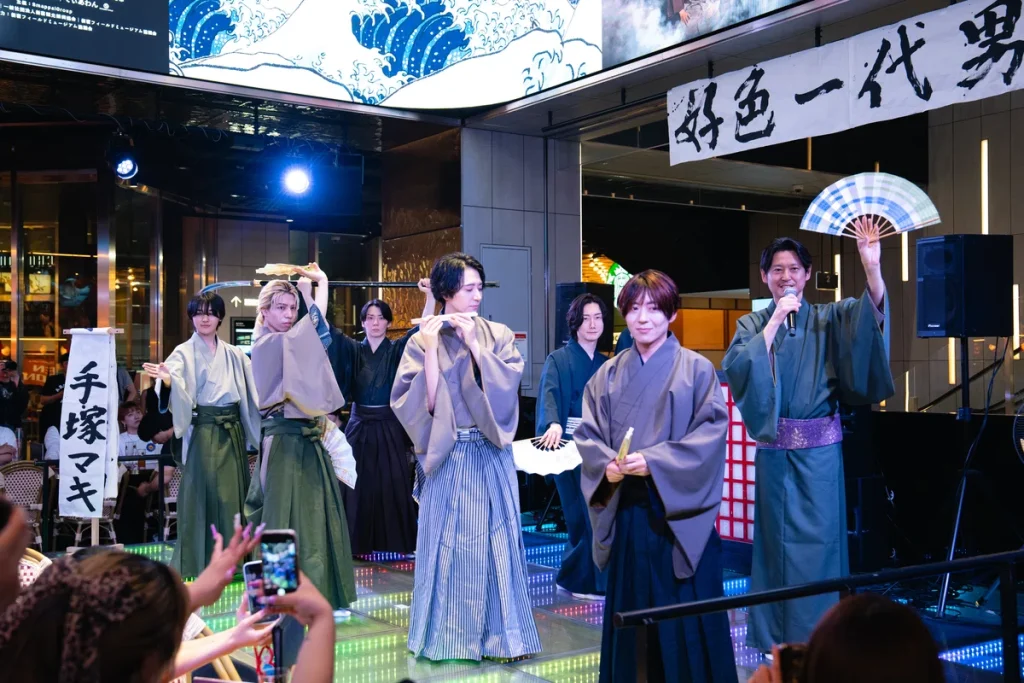
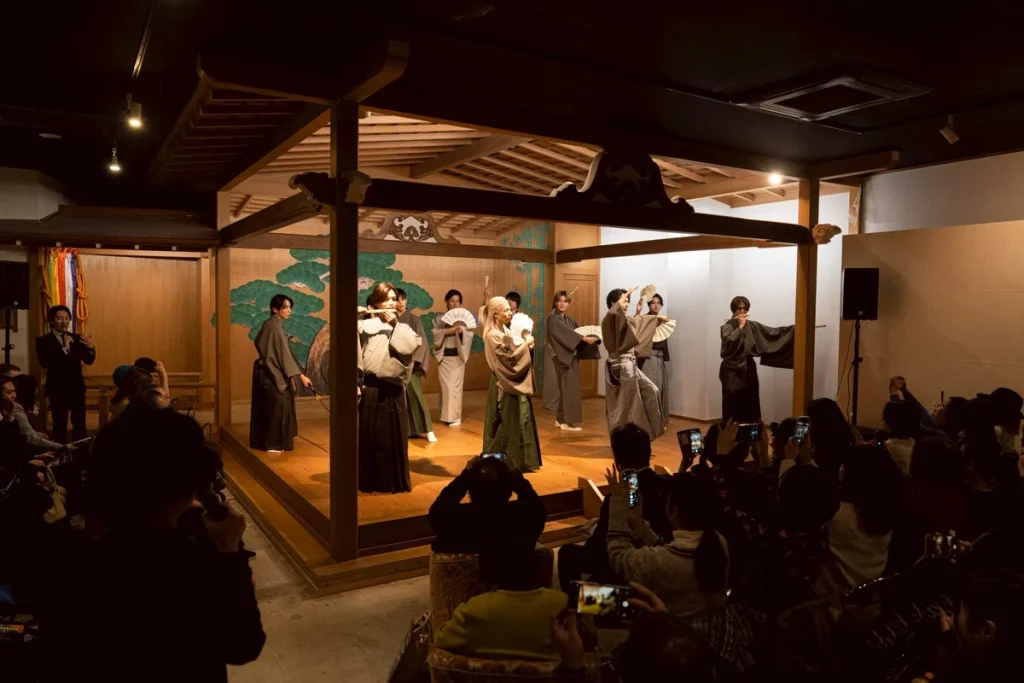
Since June 2024, the hosts of Smappa!Group has been studying Nihon Buyo (Japanese traditional dance) under Yamamura Wakashizuki, forming the dance group Koshoku Ichidai Otoko: The Life of an Amorous Man. On May 27, 2026, the group stepped beyond its home stage at the Shinjuku Kabukicho Noh Theater to give its very first performance at an outside venue.
The occasion marked another milestone for the group: the celebration of its newly launched official fan club.
More than simply commemorating a new chapter, the performance was also a heartfelt thank-you to everyone who has supported this unusual cultural project from the very beginning.
A Noh Spirit Meets the Neon Lights of Kabukicho
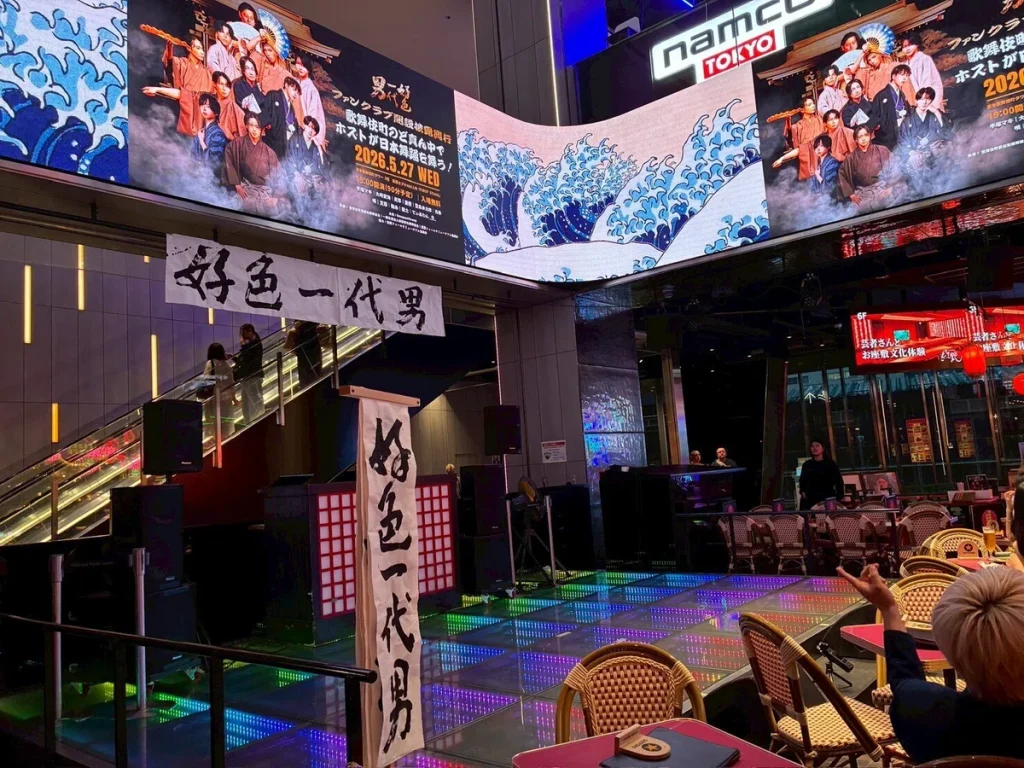
The venue was FIRST STAGE, located inside Tokyu Kabukicho Tower, rising like a spring from the very center of Kabukicho.
Unlike the quiet dignity of the Shinjuku Kabukicho Noh Theater, FIRST STAGE offered an entirely different atmosphere.
LED screens wrapped around the venue. Rainbow-colored lights illuminated the performers. Beyond the stage, neon signs stretched through the lively restaurant arcade.
It was dazzling, energetic, unmistakably urban.
Yet somehow, beneath the bright lights, there remained an unmistakably Asian atmosphere. Watching the performance, one couldn’t help but think of the cinematic cityscapes of Blade Runner—where tradition and futurism coexist in unexpected harmony.
For the performers, it was an unforgettable opportunity.
Opening the Curtain Like Hosts
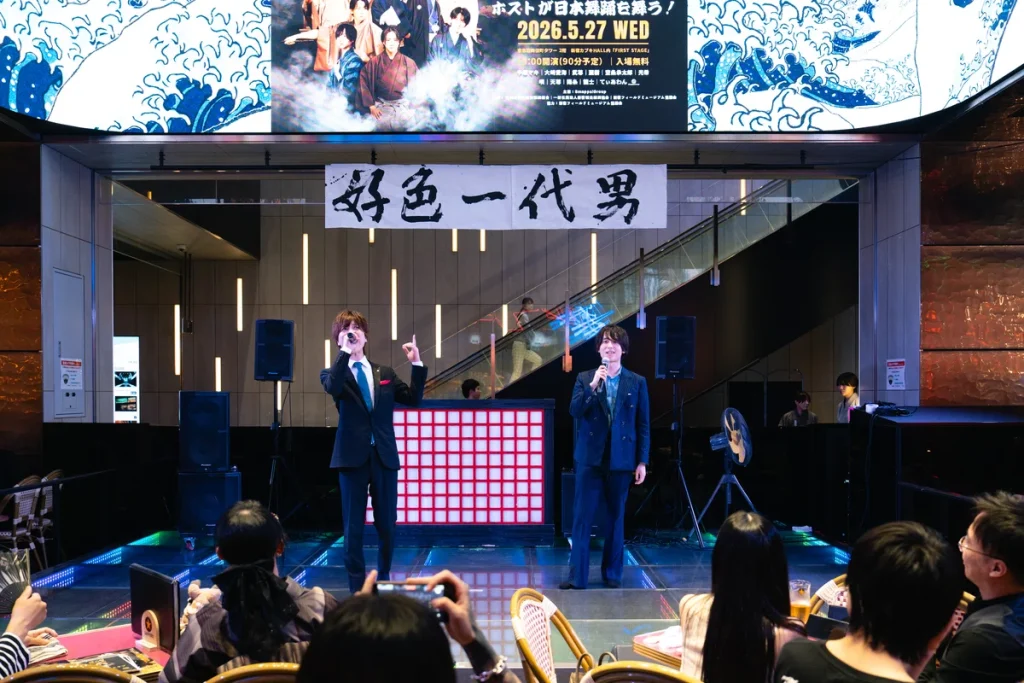
This evening’s masters of ceremony were Aki (OPUST) and Teru (Smappa! Hans Axel von Fersen).
Rather than beginning with a conventional introduction, they opened the show with something unmistakably Kabukicho—a lively microphone performance inspired by the champagne calls familiar to Japanese host clubs.
“Ei-yoisho! Ei-yoisho!” they chanted—a spirited rhythmic call similar to a collective “Heave-ho!”—with the audience echoing each phrase in response.
Hosts, opening a performance of traditional Japanese dance in the way only hosts could.
Known among the members for his energetic champagne calls, Aki led the performance with confidence while Teru’s spirited responses accelerated the tempo, instantly filling the venue with excitement.
From the very first moments, the audience understood that this would not be a conventional recital.
It was a meeting point between two worlds.
The Stories Begin
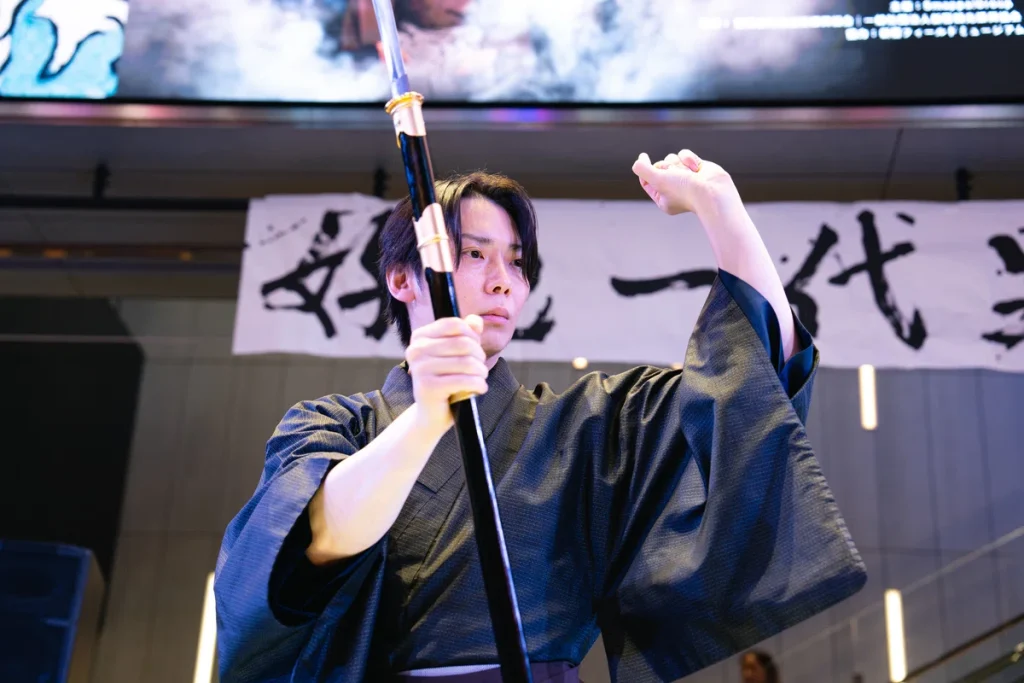
The evening opened with Narumi Osaki (Smappa! Hans Axel von Fersen) performing Nami no Ue (“Upon the Waves”).
The dance draws inspiration from the tragic warrior Taira no Tomomori, whose spirit continues to seek vengeance even after death. Wielding a naginata (traditional pole weapon), Narumi delivered a powerful performance filled with dramatic intensity that immediately captivated the audience.
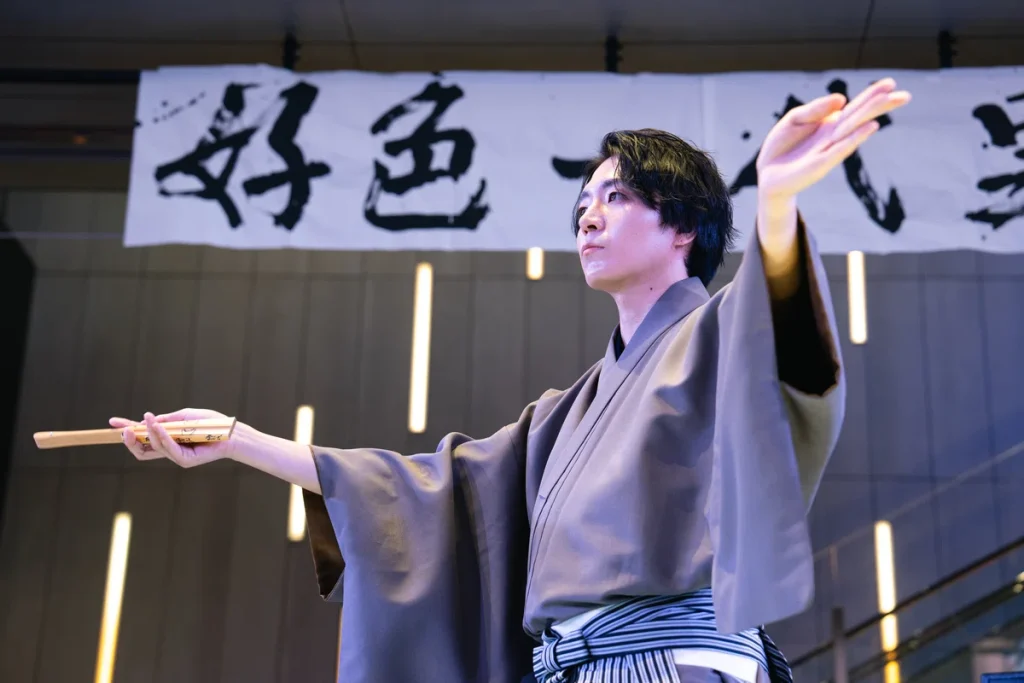
Next came Uta (CURE) with Ichinotani, based on the story of Taira no Atsumori, the young samurai remembered for his extraordinary love of the flute.
Even on the battlefield, Atsumori could not abandon music.
Throughout the dance, Uta transformed a folding fan into a flute, then moments later suggested riding horseback, shifting gracefully between scenes as the story unfolded. The changing rhythm of the choreography reflected both the elegance and tragedy of its protagonist.
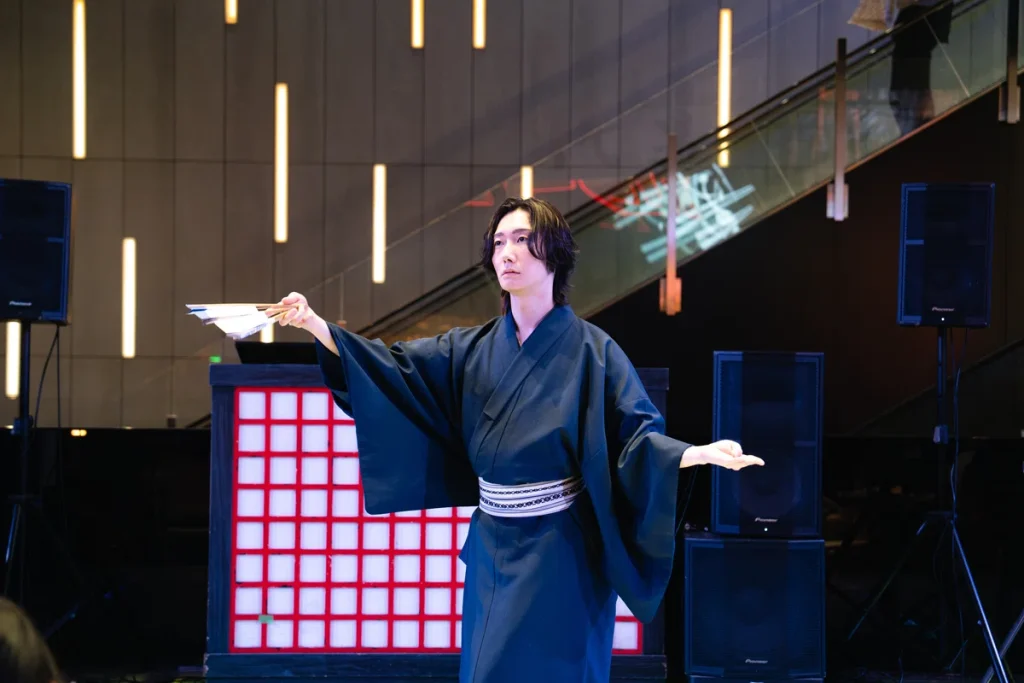
The mood then softened with Mitsuki (OPUST), performing Kusa no Ha (“Leaves of Grass”).
A gentle onna-mai (female-style dance), the piece likens the bond between lovers to the autumn moon. Mitsuki’s quiet, graceful movements filled the stage with melancholy and delicate emotion.
Dance That Stops People in Their Tracks
One unexpected joy of performing outside the Noh Theater was the audience itself.
Visitors from overseas, people exploring Kabukicho, and passersby who knew nothing about the event gradually gathered around the stage.
Something was happening.
Curious faces stopped, watched, smiled, and stayed.
Unlike performances inside the Noh Theater, this audience had not necessarily come looking for Japanese dance.
Instead, Japanese dance found them.
In many ways, this felt perfectly aligned with the group’s mission—to allow people to encounter traditional culture naturally, in the everyday life of Kabukicho, without barriers or formality.
One of the evening’s highlights came when Jotaro Kujo (Smappa! Hans Axel von Fersen) took the stage with Matsuzukushi (“A Collection of Pine Trees”).
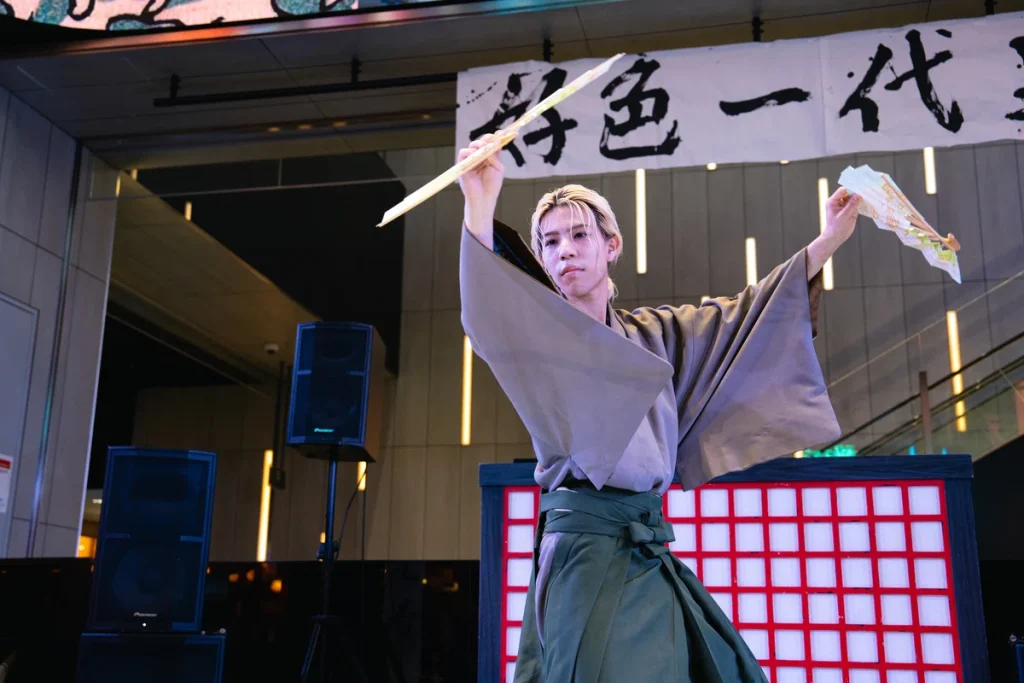
The piece celebrates famous pine trees from across Japan in the style of a counting song. Using two folding fans throughout the performance—a considerable technical challenge—Jotaro demonstrated a series of elegant fan techniques that drew enthusiastic applause from the audience.
The evening was also filled with personal milestones.
For Tier1 (CURE), it was both his stage debut and his very first solo performance.
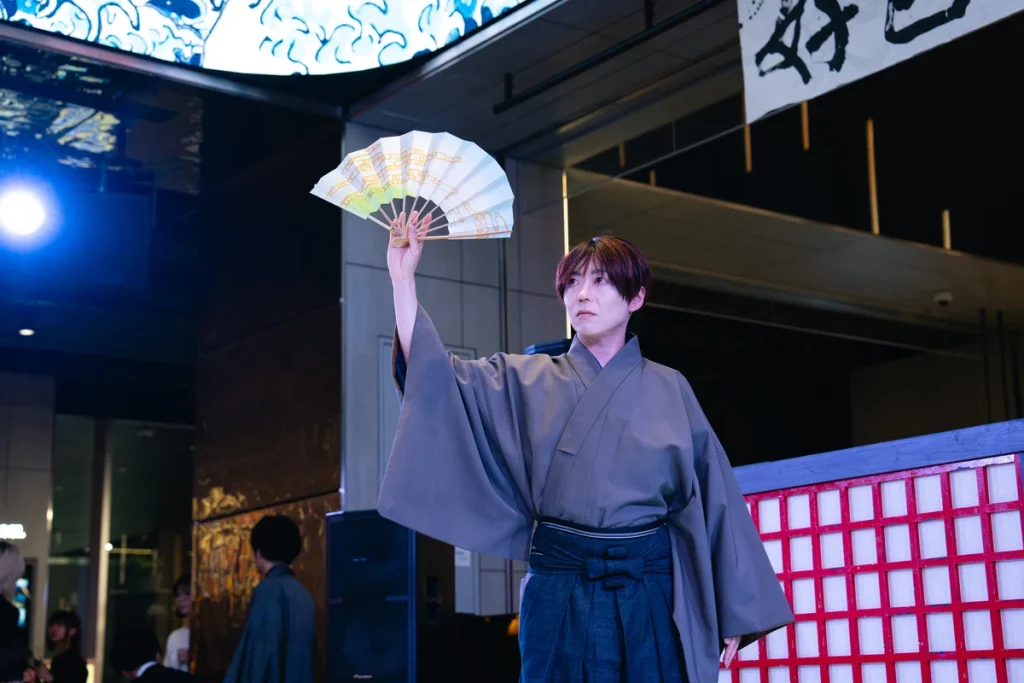
For Hiito (CURE), it was his first solo appearance as well.
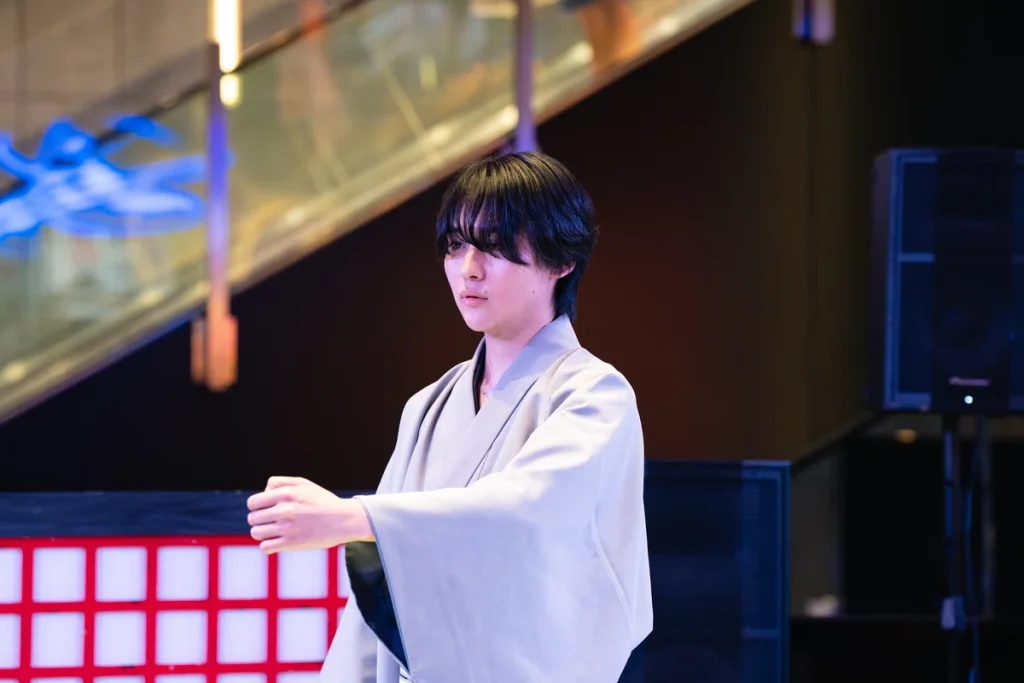
Even Jotaro’s two-fan choreography marked a new challenge.
Each recital becomes an opportunity for every member to take one more step forward.
First Steps on Stage
Hiito performed Itako Dejima, a dance whose melody may sound familiar to some audiences.
Part of the music appears in Fujimusume (The Wisteria Maiden), recently featured in the acclaimed film Kokuhō (National Treasure). The melody itself is believed to originate from boatmen’s songs on the Tone River and is considered one of the roots of the popular dodoitsu song tradition.
Hiito’s warm personality naturally emerged through the performance, expressing both tenderness and quiet longing.
Every Journey Begins with
Takasago
For his first appearance on stage, Tiawan performed Takasago.
Within the Yamamura School, Takasago is often the very first dance students learn. It introduces the essential vocabulary of Nihon Buyo—from posture and sliding footwork to the handling of the folding fan.
Though visibly nervous before the performance, Tiawan later shared that he had enjoyed every moment.
Afterward, audience members even offered him ohineri—traditional tips wrapped in paper—a joyful reminder that old customs still have a place in contemporary performances.
It was a fitting beginning.
Dancing Together
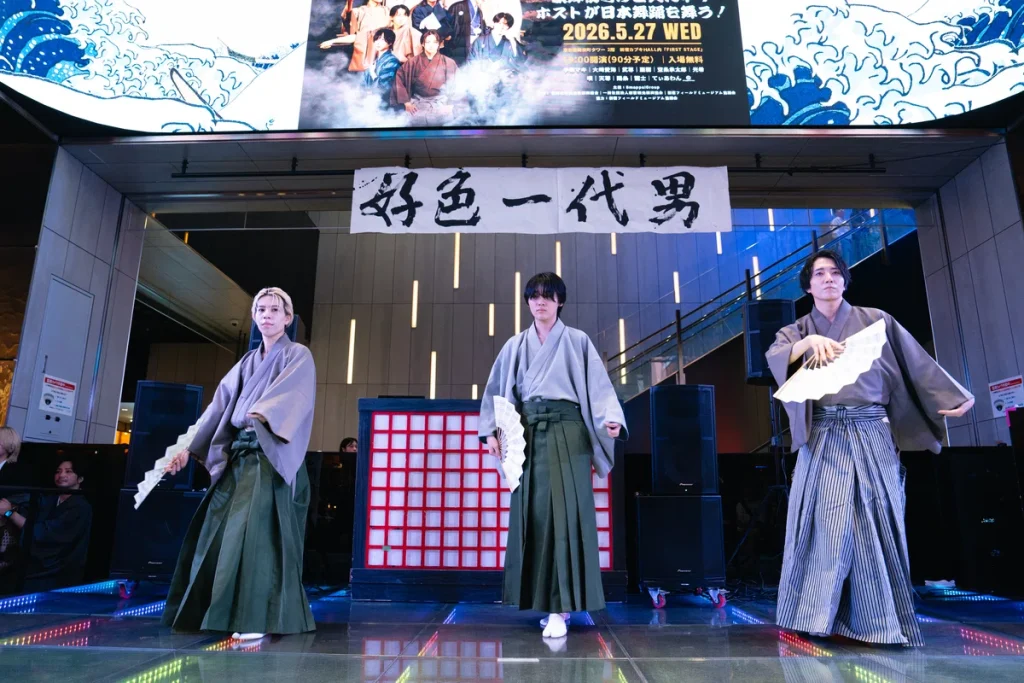
The program continued with Matsu Chiku Bai (Pine, Bamboo and Plum), performed by Jotaro, Hiito, and Uta.
Representing three plants that remain resilient through winter, the dance symbolizes perseverance, prosperity, and celebration.
It was a perfect choice for commemorating the launch of the fan club.
Although the trio admitted they still had much to learn, their shared performance reflected exactly what the group has become over the past two years—not perfect, but constantly growing together.
The Dance That Marks a Lifetime
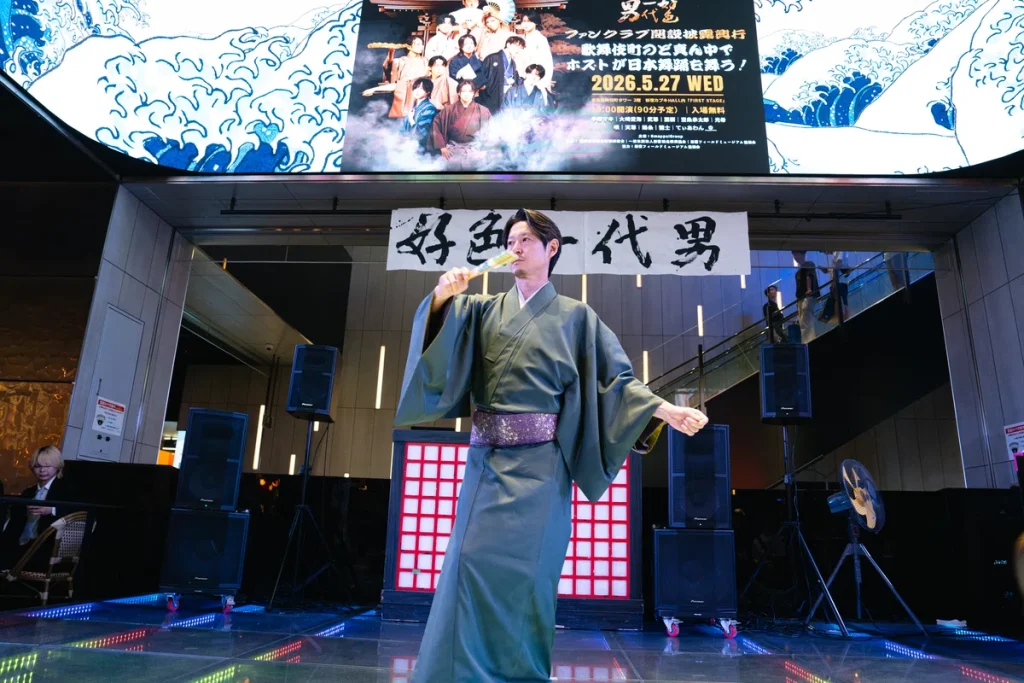
The final performance belonged to Maki Tezuka, founder of Koshoku Ichidai Otoko, who presented Yamamura Mai.
Within the Yamamura School, this dance carries special significance.
It is the piece students perform when seeking professional recognition. Successfully completing it leads to receiving a stage name beginning with “Yamamura”—a symbolic acknowledgment of mastery within the school.
During the group’s previous recital, Tezuka had performed only the first half.
This evening, he completed the entire work.
Wakashizuki later pointed out one detail that audiences might easily overlook.
“When the lyrics speak of flowers,” she explained, “he is actually looking toward the flowers.”
Tiny gestures like these embody the subtle storytelling that defines Nihon Buyo.
As founder of the project, Tezuka led not only with words but with his own performance.
More Than Technique
Watching everyone perform that evening, Wakashizuki’s first comment continued to resonate.
“Everyone looks like they’re truly enjoying themselves.”
The performers seemed liberated by the unfamiliar venue.
Rather than being overwhelmed by the brilliant lights of Kabukicho Tower, they seemed to bloom beneath them.
For many audience members, this was their first encounter with Japanese classical dance.
Others had simply wandered in while exploring Kabukicho.
Yet for seventy-five minutes, traditional performing arts became something immediate, approachable, and alive.
Perhaps that is precisely what Koshoku Ichidai Otoko hopes to achieve.
Not to preserve tradition behind glass, but to allow people to encounter it naturally, in the middle of everyday life.
“Why Should Hosts Dance?”
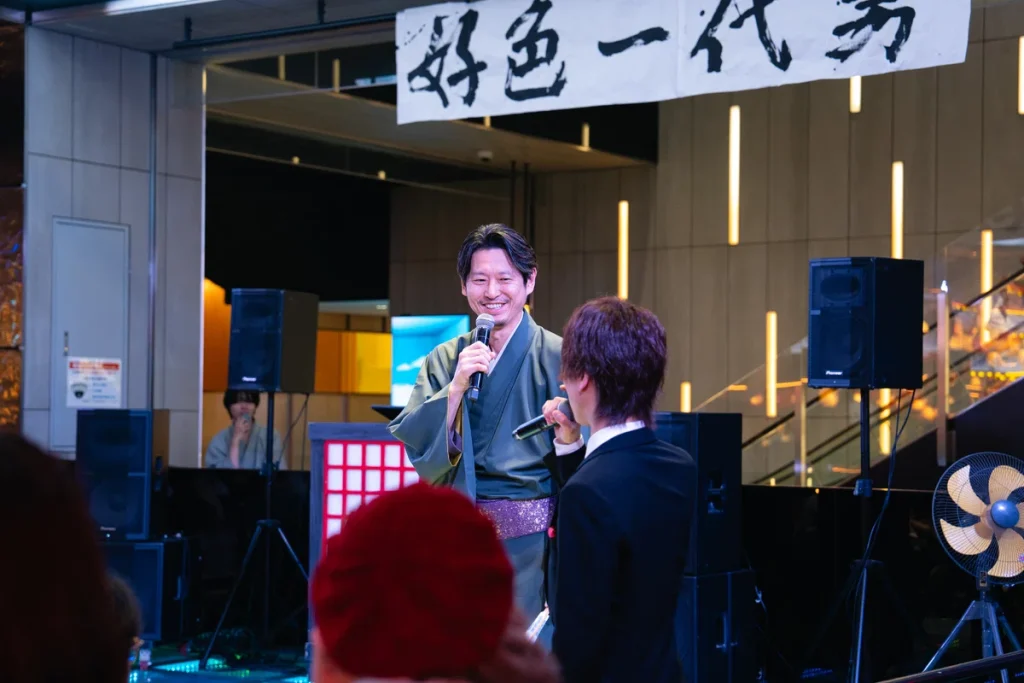
At the end of the evening, MC Aki turned to Maki Tezuka with a simple question.
“Why should hosts perform Nihon Buyo?”
Tezuka paused before answering.
“It isn’t about needing a reason. Some of the most meaningful things in life exist beyond purpose. There’s a richness in doing something simply because it enriches us.”
His words were not a rejection of meaning.
Rather, they were a reminder that not everything valuable needs to justify itself through productivity or utility.
Among the audience was rakugo performer Shofukutei Ukō, who later reflected:
“In an age where everything is expected to have a purpose, I found that to be an incredibly important perspective.”
The thought echoed something Tezuka had once said on the Shinjuku Kabukicho Shunga Exhibition WA Radio:
“Being cultured isn’t about how much you know. It’s about leaving room for imagination.”
Perhaps dance belongs to that same kind of space.
Looking Ahead
The official fan club had just welcomed its first seven members.
A modest beginning—but every journey starts somewhere.
Watching the members take their bows that evening, it became clear that Koshoku Ichidai Otoko is about more than hosts learning Japanese dance.
It is an experiment in bringing tradition into unexpected places.
A reminder that culture continues to grow when people are willing to practice, to fail, to laugh, and to keep dancing.
Continue the Journey
Koshoku Ichidai Otoko continues to perform while deepening its study of Nihon Buyo, bringing traditional Japanese dance into the heart of Kabukicho.
Official Fan Club
https://koushokuichidaiotoko.com/
Meet the Members in Kabukicho
The members of Koshoku Ichidai Otoko are active hosts at Smappa!Group.
If you’d like to meet them in Kabukicho—or explore the neighborhood with an English- or Chinese-speaking guide—visit:
Kabukicho Concierge
https://www.smappa.net/global/